



Differential Winding, Roll Quality and the Engineering Behind Independent Tension Control
A slitter can divide one parent web into ten, twenty or more neat lanes. Mechanically, that looks like one process becoming many identical processes. In reality, the instant the knives separate the web, every lane begins behaving like its own winding problem.
The reason is simple: no real web is perfectly uniform. Film, foil, paper, nonwoven, adhesive-coated stock and laminates all carry some combination of thickness variation, compressibility, coating variation, stretch and core tolerance. Once those differences are isolated into slit lanes, tiny variations begin accumulating layer after layer.
The web was one system before the knives. After the knives, every slit lane becomes its own roll.
The Small Difference That Becomes a Big Winding Problem
Consider two slit lanes that contain the same length of material but differ slightly in average caliper. As the rolls build, the thicker lane accumulates diameter faster. The two finished rolls no longer have exactly the same radius, even though they began on cores mounted to the same rewind shaft.
That matters because surface speed depends on both rotational speed and roll diameter. If two different-diameter rolls are rigidly locked to the same shaft RPM, they cannot both accept the incoming web at exactly the speed each lane requires. The larger roll tends toward excessive tension while the smaller roll tends toward insufficient tension.
The winding relationship is equally revealing: web tension is related to rewind torque divided by roll radius. As radius changes, the torque required to maintain a target tension changes too. One common mechanical command cannot perfectly satisfy multiple rolls whose diameters are no longer identical.
The symptoms can show up as loose rolls, excessively hard rolls, baggy lanes, web breaks, dishing, telescoping, starring, crushed cores or inconsistent roll hardness. With coated or adhesive products, excessive pressure can also contribute to layer-to-layer problems such as adhesive squeeze-out.
Why a Standard Locked-Core Shaft Can Reach Its Limit
A conventional locked-core air shaft is designed to grip the core firmly and transmit shaft rotation to it. That is exactly what many winding applications need. But when multiple slit rolls on one shaft begin building to different diameters, rigidly forcing every core to follow the same rotational speed becomes the problem rather than the solution.
This is why differential winding is not simply a premium version of an ordinary air shaft. It solves a different control problem. The question is not whether the shaft can grip the core. The question is whether each building roll can receive the torque and rotational freedom it needs independently of its neighbors.
Differential Winding: Controlled Disagreement
A differential shaft deliberately permits relative motion between the driven shaft and the individual building rolls. The shaft is normally driven slightly faster than the rolls require, while a controlled friction or clutching mechanism transmits only the torque needed to maintain winding tension. Each roll can therefore slip by a different amount.
A roll that has built to a slightly larger diameter can rotate at the speed appropriate to that diameter. A neighboring smaller roll can rotate differently. The rolls share a shaft, but they are no longer forced to share exactly the same rotational behavior.
Differential winding turns slip from a defect into a control mechanism.
That distinction is the heart of the technology. In ordinary shafting, unintended slip is usually something to eliminate. In differential winding, carefully controlled slip is precisely what allows the system to compensate for roll-to-roll differences.
Overspeed, Torque and Air Pressure Work Together
A differential shaft behaves much like a collection of controlled clutches. For the system to remain differential, the shaft must rotate faster than the building rolls so relative slip is continuously available. Industry technical literature commonly describes modest overspeed rather than large speed differences; excessive overspeed wastes energy as heat and increases wear.
Air pressure controls the force applied through the shaft’s tensioning or clutching elements and therefore influences transmitted torque. As roll diameter changes, the torque required for a given web tension changes. In a properly engineered winding system, shaft pressure, roll diameter, rewind speed and desired tension are therefore considered together rather than as independent settings.
This also explains why simply “turning up the air” is not a winding strategy. Excess pressure or unnecessary slip speed can increase heat, wear and, in some differential designs, core dust. The goal is enough torque and enough differential motion to control the web - not maximum pressure and maximum overspeed.
Core-Slip vs. Core-Lock Differential Winding
Differential shafts generally fall into two broad families. In a core-slip or external-slip design, the core itself slips relative to the shaft’s tensioning elements. These designs can offer useful load capacity and flexibility, but performance depends strongly on core quality, and the slipping interface can generate core dust. Lateral core restraint may also be required.
In a core-lock or internal-slip design, a locking element grips the core so the core and locking element move together; the controlled slip occurs inside the shaft mechanism instead. This can eliminate core-to-shaft rubbing as the differential interface, reducing core dust and helping prevent lateral movement or core wobble.
Where Double E Group’s Differential Air Shaft Fits
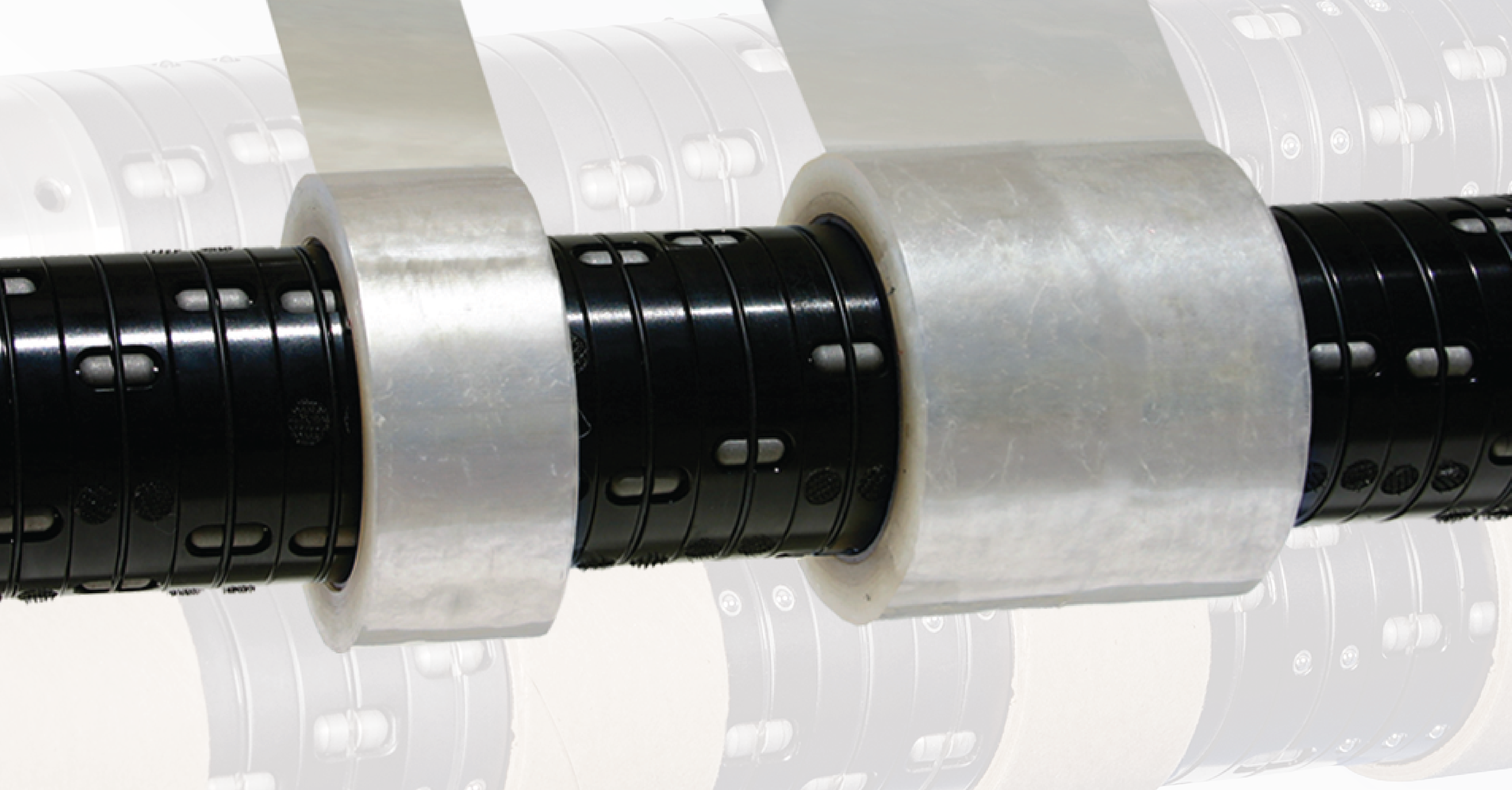
Double E Group’s Differential Air Shaft uses patented roll locks and an internal, bi-directional clutching mechanism. The roll locks engage cores independently and actuate according to core location, allowing multiple core widths to be positioned along the shaft without cones, core stops or spacers. Because the differential slip occurs internally rather than by rubbing the core against the shaft surface, the design is intended to avoid core dust and side-to-side core movement associated with direct-friction approaches.
Current Double E Group specifications include controlled tensions below 0.15 PLI, slit widths down to 1/2 inch, face lengths to 100 inches and shaft diameters from 70 mm through 10 inches. Those capabilities make the design particularly relevant where narrow rolls, delicate webs or mixed slit widths make small tension errors increasingly visible.
Why Narrow Slits Magnify the Problem
A wide web can distribute total tension across substantial width. Once that same web is divided into narrow lanes, each lane carries only a fraction of the total force. Small mechanical differences that were insignificant at full width can become meaningful relative to the low tension required by an individual narrow strip.
That is why labels, thin films, foils, battery materials, specialty laminates and other tension-sensitive narrow webs can expose weaknesses in a rewind system quickly. Differential winding does not make poor material perfect, but it gives each lane the freedom to accommodate its own build instead of forcing all lanes to compromise around one common shaft speed.
Why Differential Winding Matters for Finished Roll Quality
Converters do not ship “excellent shaft RPM.” They ship rolls. The customer sees edge quality, roll hardness, telescoping, starring, crushed cores, loose wraps and whether the roll behaves properly in the next process.
Differential winding is valuable because it moves control closer to the individual roll. Gauge variation may originate upstream, but the commercial consequence appears downstream as roll quality. A system that allows each slit roll to find the torque and speed relationship appropriate to its own build can turn unavoidable material variation into manageable process variation.
Differential Winding Does Not Replace Good Winding Practice
A differential shaft is powerful, but it is not a magic eraser. Good web handling still depends on stable unwind tension, appropriate winding tension, sound cores, correct alignment, suitable nip or lay-on conditions where applicable, accurate controls and a shaft sized for the roll load and machine geometry.
Taper tension may still be required as roll diameter increases. Load-cell or diameter feedback may improve control. Excessive overspeed can create heat. Poor cores can create their own problems. And if clutching torque is set so high that the differential elements cannot slip, the system can behave like a very expensive locked shaft.
The purpose of differential winding is not to force every roll into equality. It is to give every roll enough independence to reach the same quality target.
When Should a Converter Consider a Differential Shaft?
The practical trigger is usually evidence that individual slit rolls are not building consistently on a common locked-core rewind. If the worst incoming material produces slack lanes, large roll-to-roll hardness differences, dishing, telescoping, web breaks or other lane-specific defects, differential winding deserves investigation.
The strongest applications tend to combine multiple slit rolls with meaningful caliper variation, low or sensitive winding tensions, narrow slit widths, demanding roll-quality requirements or materials that cannot simply absorb dimensional differences through elastic stretch or radial compression.
A Better Question for Troubleshooting
When one roll in a rewind set is tight and the roll beside it is loose, the instinct is often to ask what global tension setting is wrong. Differential winding suggests a better question: are we trying to control multiple physically different rolls as though they were still one roll?
Once the parent web has been slit, the answer may be yes. And sometimes the most effective way to make the finished rolls more consistent is to stop requiring them to behave identically while they are being built.
Frequently Asked Questions: Differential Air Shafts
What is a differential rewind shaft?
A differential rewind shaft allows multiple rolls on one rewind shaft to rotate at slightly different speeds while receiving controlled torque. It is used to compensate for differences in roll diameter, web length and lane tension during slitting and rewinding.
Why do slit rolls build to different diameters?
Small differences in web caliper, coating thickness, lamination, compressibility and other material properties accumulate layer after layer. Once the web is slit, each lane can therefore build at a slightly different rate.
Why can’t a standard air shaft solve this?
A standard locked-core shaft intentionally prevents relative rotation between the shaft and core. If several rolls build to different diameters, forcing all of them to the same RPM can create different lane tensions. A differential shaft introduces controlled slip so each roll can rotate appropriately.
Does a differential shaft intentionally slip?
Yes. Controlled slip is fundamental to differential winding. The shaft is driven slightly faster than the building rolls and clutching or friction elements transmit controlled torque while allowing each roll to slip independently.
What is differential shaft overspeed?
Overspeed is the small speed difference between the driven differential shaft and the building rolls that keeps the differential elements in a slipping condition. The correct amount depends on the shaft, material, speed and winding system. Excessive overspeed can create unnecessary heat and wear.
How does air pressure affect winding tension?
In pneumatic differential shafts, air pressure influences the normal force at the tensioning or clutching interface and therefore the torque transmitted to the roll. Because the torque needed for a target web tension changes as roll radius changes, pressure is commonly managed as part of the winding-control strategy.
What is the difference between core-slip and core-lock differential shafts?
Core-slip designs allow the core to slip directly against tensioning elements on the shaft. Core-lock designs grip the core and place the controlled slip inside the shaft or cartridge. Core-lock designs can reduce core dust and lateral core movement, while core-slip designs may offer advantages in some larger-core or higher-load applications.
Can differential shafts reduce core dust?
Internal-slip/core-lock designs can greatly reduce or avoid dust created by rubbing the core against the shaft as the differential interface. Dust from other sources in the converting process is, of course, unaffected.
What roll defects can differential winding help address?
Where defects are driven by lane-to-lane diameter or tension differences, differential winding can help with inconsistent roll hardness, loose rolls, excessively tight rolls, dishing, telescoping, starring, individual web breaks and related roll-build problems.
Does differential winding eliminate gauge variation?
No. It does not change the material. It compensates for some of the winding consequences of gauge and dimensional variation by allowing individual slit rolls to build at the speed and torque relationship they require.
When is differential winding most useful?
It is especially useful when multiple slit rolls are wound on one shaft and the material has meaningful thickness variation, the slits are narrow, tensions are low, roll-quality requirements are demanding or locked-core winding produces lane-specific defects.
Can different core widths be run on the same differential shaft?
Depending on shaft design, yes. Double E Group’s Differential Air Shaft is designed to accommodate multiple core widths positioned along the shaft, with roll locks that engage according to core location.
How narrow can Double E Group differential shafts wind?
Double E Group currently specifies slit widths down to 1/2 inch and controlled tensions below 0.15 PLI for its Differential Air Shaft. Final sizing and suitability should be confirmed for the application.
Do differential shafts require special tension controls?
They require a winding system capable of maintaining appropriate shaft speed and torque. Depending on the machine, control may be open-loop using roll-diameter information or closed-loop using direct tension feedback such as load cells. Application requirements determine the appropriate control strategy.
Can a differential shaft be retrofitted to an existing slitter-rewinder?
Often, yes, but retrofit suitability depends on journal dimensions, drive arrangement, available continuous air supply/rotary union, roll loads, core sizes, face length, speed and the machine’s tension-control architecture. Engineering review is recommended.
How do I know whether I actually need differential winding?
A useful practical test is the quality of the rolls produced from your most difficult material on a locked-core rewind. Persistent lane-specific slackness, hardness variation or roll-build defects are strong reasons to evaluate differential winding rather than continuing to chase one global tension setting.
Not Sure if Differential Winding Is Right for Your Application?
If you're seeing inconsistent roll hardness, slack lanes or other roll-build problems across slit rolls, the rewind shaft may be part of the equation. Core size, slit width, web material, roll weight, speed and tension requirements can all influence the right approach.
Contact Double E Group to discuss your winding application and determine whether a differential shaft is the right solution.