
Every operation has its challenges. The right solution makes all the difference.
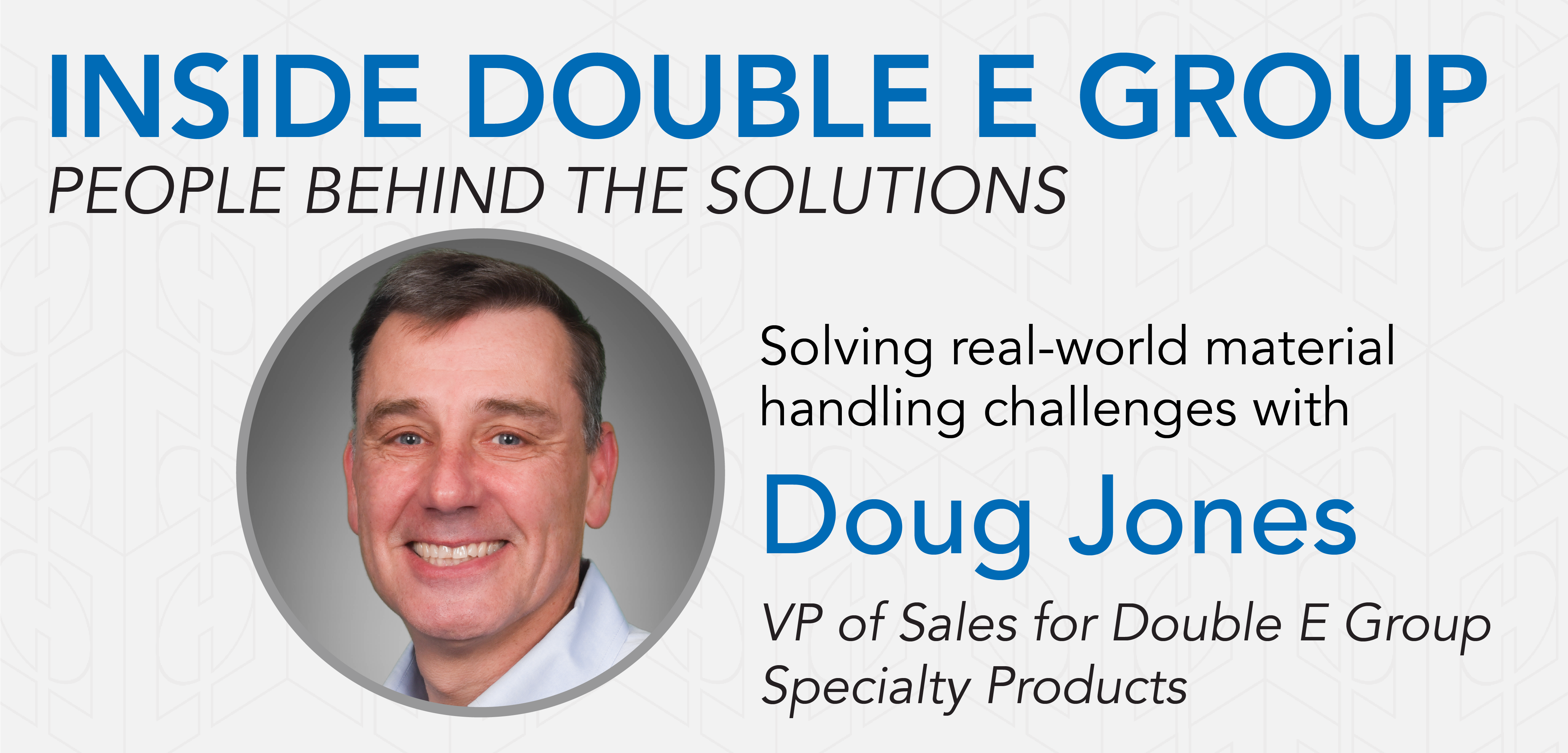
Solving real-world material handling challenges with Doug Jones - VP of Sales for Double E Group Specialty Products
Today's manufacturers are under constant pressure to improve safety, increase throughput, and make better use of available space. The right equipment can improve workflow, reduce risk, and support productivity. We sat down with Doug Jones, VP of Sales for Double E Group Specialty Products, to discuss the material handling challenges manufacturers face and why the best solutions are built around the application, not the other way around.
For those who may not be familiar with this side of Double E Group, what does “Specialty Products” actually mean?
The focus of my team is material handling equipment designed around the need for safe and ergonomic handling solutions for our customers. This includes flexible designs including hoist, fixed manipulator, and floor-based roll handling systems, shaft handling, and custom lift-and-turn devices.
Our specialty products also include a complete line of Appleton RollMovers, CartMovers, and core cutters.
When it comes to material handling, our solutions are designed to meet the specific needs of each customer’s application. Ergonomic handling and safety are driving more companies to reevaluate how they handle heavy rolls, tight spaces, or their current system involving a lot of manual lifting and turning material. When working with our customers, our goal is to reduce risk and injury to their operators and improve productivity.
With our core cutters, it’s not just about getting a clean cut, but about doing it consistently with less waste, keeping your operators out of harm’s way, and making sure production doesn’t slow down
When you first walk into a facility, what are you looking for?
It’s important for our technical team to get out onto the plant floor and watch the process. We want to see how material is actually moving through the plant, understand the operator’s pain points and how we can improve the operation.
You can see it relatively quickly where the process slows down and where something just looks harder than it should be. I’m also always looking at the available space on the plant floor since it’s often limited. That becomes a major factor in building the right solution.
After the initial walkthrough, we get into the details — roll sizes, weights, core and shaft setups, how often they’re cutting cores or moving material. Once you understand that, it becomes a lot clearer where the opportunities are to improve things.
You mentioned noticing limited space. Are there ways you work around that?
Today’s customers are trying to increase throughput in their current space. It’s very rare that you see a plant with extra room for future equipment, so we have to make solutions work within what’s already there.
Sometimes, it’s a hoist-based system that can cover multiple areas without taking up floor space. This would lend itself to our MRT and Dotec Lift Assists. Other times, portable floor units are the key, like our ERH and Speedy powered roll handlers for lifting and turning. Or it could be as simple as moving a roll along a production floor with our RollMovers.
With cores, it’s about taking control of your production and reducing costs. Many facilities store a lot of pre-cut cores, which takes up valuable space. Investing in a core cutter lets them cut what they need, when they need it. This not only frees up floor space but can also reduce costly inventory.
We want space to be used efficiently, and we have ways to make that happen.
Safety and ergonomics are coming up more and more in conversations. What are you seeing?
That’s driving a lot of conversations right now. Many facilities are still relying on manual lifting, reaching, turning, or cutting, and over time that can create both safety concerns and inconsistencies in production.
That’s really where our material handling equipment and core cutting solutions come into play. Whether it’s handling heavy rolls and shafts with hoist- or floor-based systems, hoisted Dotec Lift Assist systems, RollMovers, or a safer, more consistent core cutting process, the goal is the same — reduce strain, improve efficiency, and created a safer, more controlled operation.
Most companies are realizing that when you improve safety and ergonomics, productivity usually improves right along with it. At the end of the day, it’s all connected.
A lot of people hear “material handling” and immediately think rolls. Does your team’s work go beyond that?
Absolutely. Roll handling is a big part of what we do, but the reality is that’s just one small portion of it.
We’re involved anywhere material needs to be lifted, turned, moved, positioned, and just generally handled safely and efficiently. That could be billets, dies, wire reels, fixtures, sheets of glass, lumber shafts, cores, finished rolls, carts, drums, bags, boxes, batteries – just about anything that needs to be picked and placed.
What makes Double E Group stand out in this space?
We’re not limited to one type of solution, and that’s a big advantage for our customers. We listen to our customers and understand what they need for a solution. Our talented design engineers and technical sales teams will walk our customers through their process and get them the solution they need.
Double E Group already has a strong core of product offerings with our shafts, chucks, trim removal systems, rollers, and web handling products. My team helps build on that with specialty handling solutions to support the facility’s workflow, safety, and efficiency. Our partnerships with Dotec and Armanni Lifting Solutions give us even more ergonomic lifting solutions for handling a wider variety of materials and applications.
Having access to all of those products, and the fully customizable nature of what we do, means we can build solutions around the customer’s specific operation instead of making them adapt their process to use our equipment. Experience has taught us what works in real production environments, not just in theory. At the end of the day, the solution has to work reliably and make an operator’s job easier.
Last one — what do you enjoy most about this kind of work?
Walking into a facility where people have been dealing with the same issue for years and being able to say, alright, let’s find a better way to do this. Every operation is different, so we’re never delivering a copy-and-paste solution. It keeps the job interesting.
It’s great to see the process come together once the solution is in place. When the operators are more comfortable, the workflow is smoother, and our customers start seeing real improvements in their day-to-day operations right away — that’s rewarding!